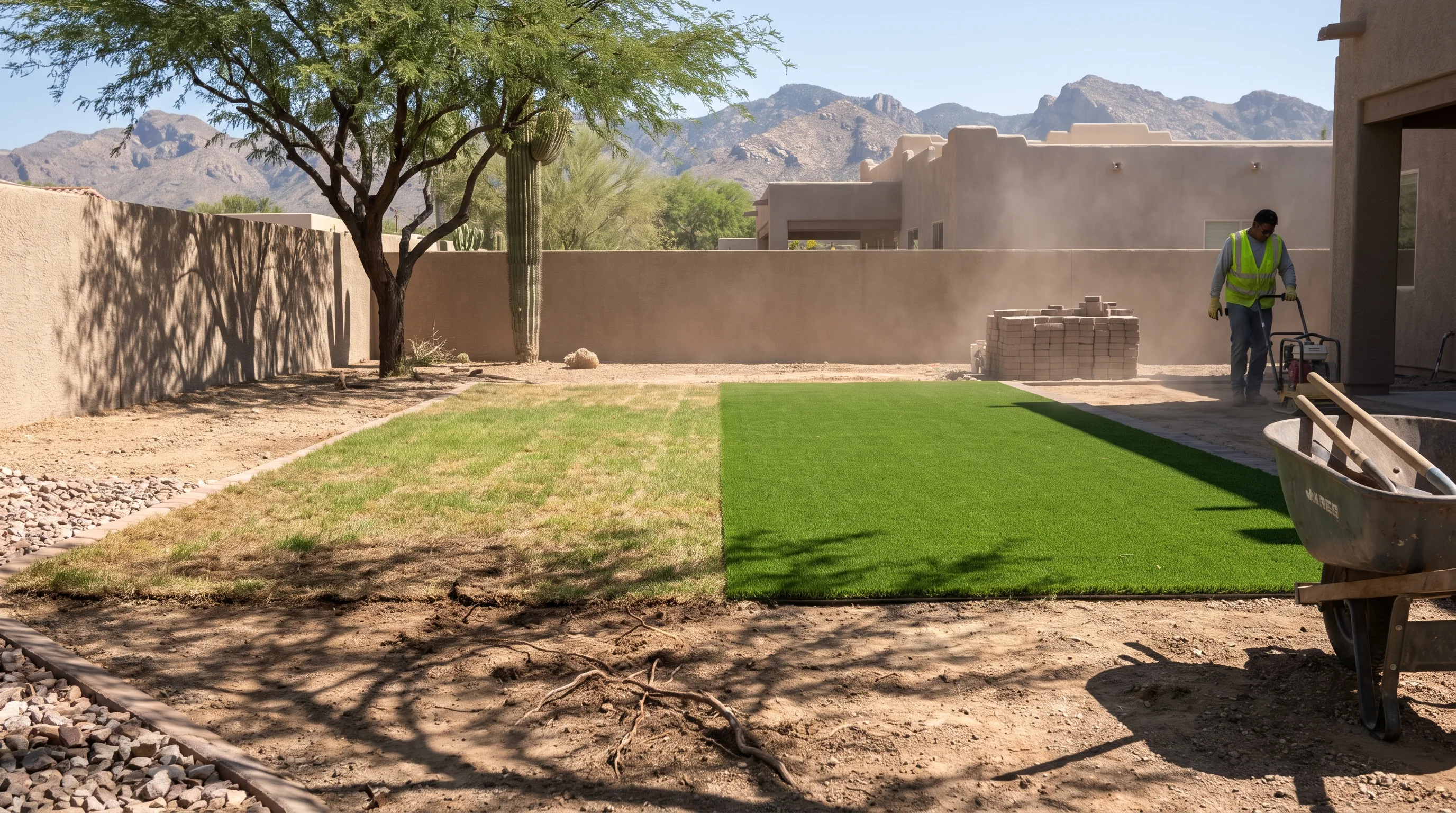
In this climate, turf wins on water, on appearance through the summer and on effort. Real grass wins on surface temperature, on how it feels, and on what it does for the space around it. Everything else is detail.
We install turf, so treat this piece with the scepticism that deserves, and then read the heat section, because it is the part most turf companies leave out and it is the reason some Tucson homeowners regret the decision.
The argument that usually settles it
Keeping a real lawn alive through a Tucson summer takes a serious and continuous amount of water, and it takes the most water exactly when water is most constrained. Even well watered, most lawns here look tired from June through August unless they are overwatered.
Turf uses none. That is the whole case, and it is a strong one in a desert city.
Turf does still get rinsed, particularly where dogs use it, but that is occasional rather than scheduled.
The honest problem with turf
Artificial turf gets hot in direct sun. Hotter than the air, and hotter than most people expect, including hotter than plain concrete in the same position. There is no thermal mass to spread the heat and the blades absorb a lot of what hits them.
Real grass does the opposite. A living lawn cools the air above it through evaporation, which is a genuine and noticeable effect on a hot afternoon.
That is the trade off, and it is the one that decides whether people are happy with turf two summers later. A turf area in full unshaded afternoon sun in July is not somewhere anyone will stand barefoot. A turf area with a tree over it, or under a ramada, or that gets afternoon shade from the house, is completely fine.
Our practical position is that turf and shade should be planned together. If the space you want to cover has no shade at all and no prospect of any, we will tell you that before you buy it.
Turf usually wins, with conditions
Dogs destroy real lawn here. They create tracks, they dig, they burn patches, and a lawn that is already stressed by heat does not recover.
Turf handles all of that, provided it was built for it. That means a free draining base, an infill chosen for odour management, and a rinsing routine. Turf installed for dogs without those three is where the complaints about smell come from, and once it is installed there is no fixing it from the top.
The other consideration is heat again. A dog will not use a turf area that is too hot, and dogs are less good than people at deciding to wait until evening.
How each one actually reads
Good turf looks convincing. The products that read as artificial are the very green, very uniform, very dense ones. A mix of blade colours including a brown thatch layer, varied blade shapes and a moderate density is what makes a turf lawn look like a lawn.
It still does not feel like grass. It is warmer, firmer and more uniform underfoot. Some people never notice and some people notice every time.
Real grass, when it is thriving, is better than any synthetic product. The question in Tucson is how many months of the year it will actually be thriving.
High up front, low to run
Turf costs considerably more to install than seeding or laying sod. After that it costs almost nothing to run, while a real lawn costs water, mowing, fertiliser and periodic repair for as long as it exists.
Turf also has a finite life and will eventually need replacing, which sod does not in the same way. Where the crossover point sits depends on water rates, on how the lawn is maintained and on how long you stay.
The version we usually end up building
For most Tucson yards, a defined panel of turf rather than a wall to wall turf yard. A shaped area, sized for what people actually use it for, sitting alongside paving, planting and granite, with shade over at least part of it.
That gives you the green, the softness underfoot and the dog area, without turning the whole rear yard into an unshaded heat surface. It also costs less than covering everything.
And if the space is heavily shaded and permanently damp, or has to take vehicles, we would suggest something else entirely.
Worth talking through before you commit
Turf is a permanent decision that is expensive to reverse, and the two things that decide whether you will be happy with it are shade and drainage. Both are worth twenty minutes of someone standing in your yard.