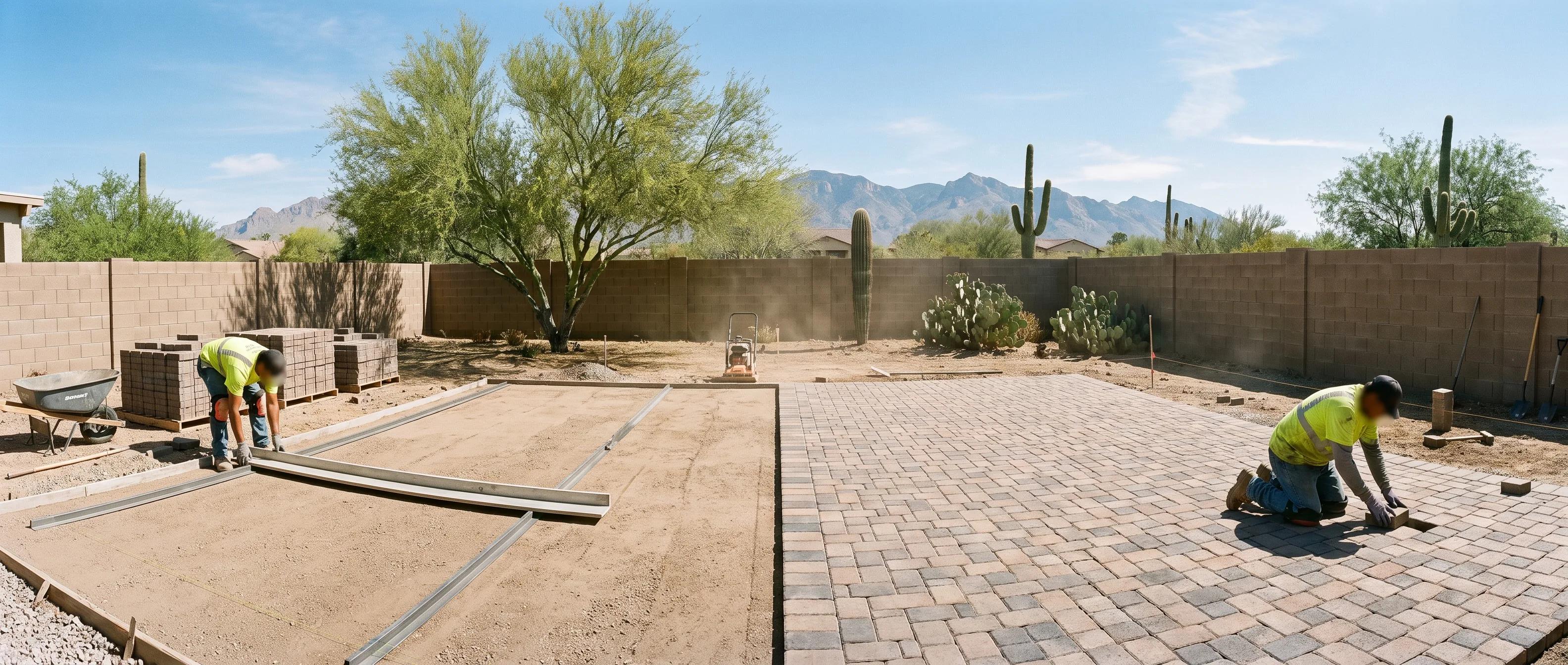
Paver Patios in Tucson
Laid on a compacted aggregate base, edged so the field cannot creep, and pitched to send monsoon water away from the house rather than at it.
- Excavation and base depth quoted, not assumed
- Plate compacted in lifts, not once at the end
- Edge restraint on every open edge
- Fall designed away from the structure
[ 01 ]The part you cannot see
The patio is the easy part
Setting pavers is skilled work but it is not the difficult part of a patio, and it is not where patios fail. What decides whether a paver patio is still flat in ten years is what happened before the first paver went down: how deep the excavation went, what the base is made of, how many passes the compactor made, and whether there is anything holding the outside edge.
You cannot see any of that once the surface is on. That is exactly why it is the first thing cut when a quote needs to be cheaper. A patio built on two inches of loose base and no edge restraint looks identical to a properly built one on the day it is finished. The difference shows up as a dip near the door, a wandering edge, and joints that open wide enough to grow weeds.
In Tucson there is a further complication. Caliche sits under a lot of these lots at unpredictable depths. Where it is solid it makes an excellent bearing surface. Where it is a broken layer over loose soil it holds water against your base and lets the whole thing move. Which of those you have is not something anyone can tell you from the driveway, so we find out before quoting a depth.
[ 02 ]Scope
What we build
Back yard patios
The main entertaining surface, sized around what you actually put on it. A table for six needs more clearance than people expect once the chairs are pulled out, and a patio that is 200 square feet too small is the most common regret we hear about.
Patio extensions off an existing slab
Adding paver area against a slab that is already there. The tie in detail is the whole job: the transition has to be level enough not to trip on, and detailed so water does not collect in the seam between old and new.
Full yard paver fields with planting
Larger installations where the paver area, the DG or gravel fields and the planting beds are laid out together, with curbing or restraint between them so the materials stay where they were put.
[ 03 ]In every scope
What is included
Excavation and subgrade
We dig to a depth set by the ground we find and the use of the area, remove the loose material, and compact the subgrade before any base goes in. If caliche changes the plan, you hear about it that day rather than in the final invoice.
Base and bedding
Aggregate base placed and compacted in lifts, then a screeded bedding layer to the correct thickness. The bedding layer is not a leveller for a bad base and we do not use it as one.
Laying, cutting and edging
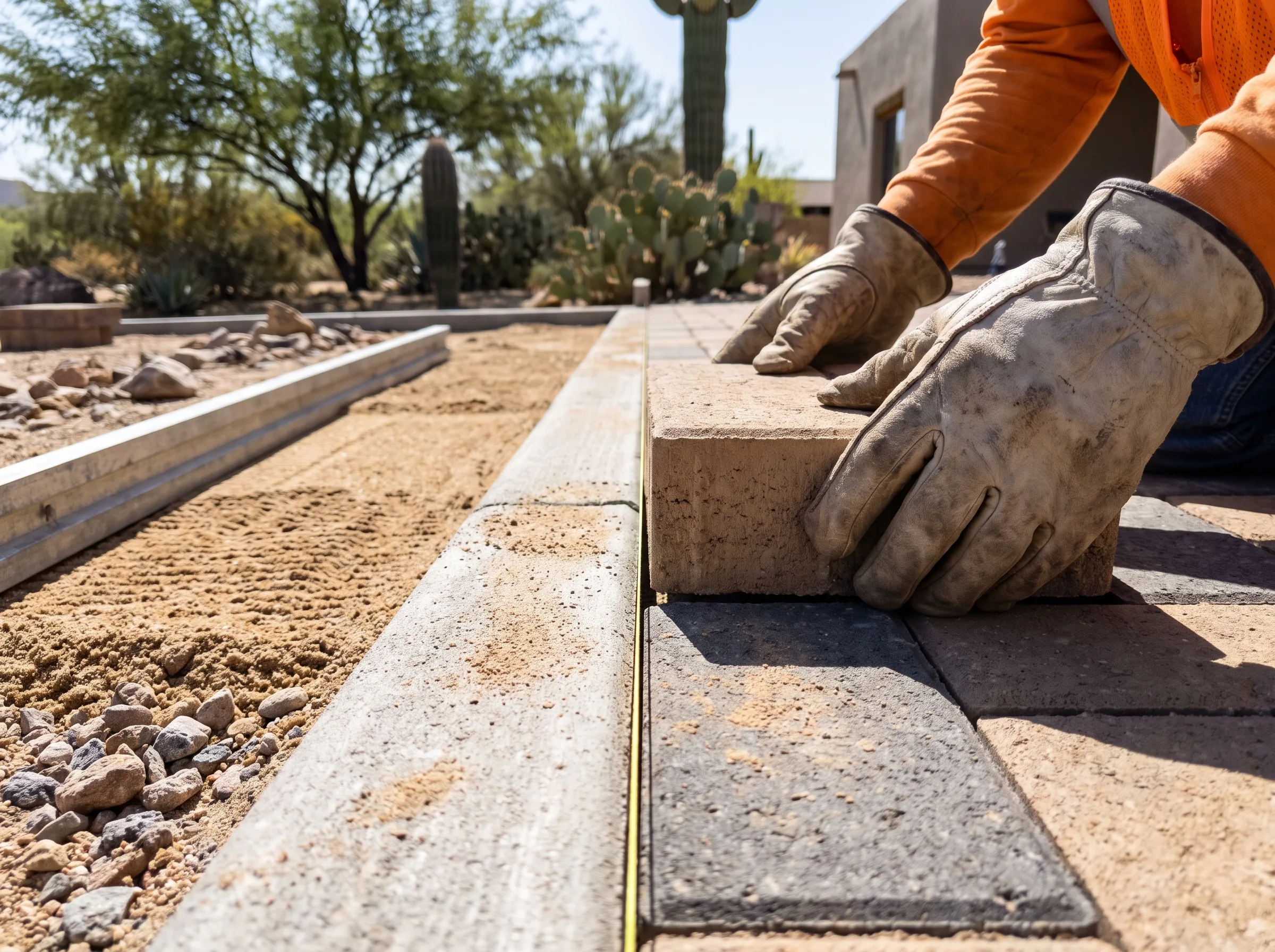
Pavers laid to a string line in the pattern agreed, cuts made on a saw rather than snapped by eye at the borders, and a restraint spiked along every edge that is not held by a wall or a footing.
Joints, compaction and clean up
Joint sand swept in, the field compacted with a protective pad, joints topped and settled, then the surface washed down and the site cleared. Offcuts and spoil go with us.
[ 04 ]How it runs
How the build runs
- 01
Site visit and probe
We walk the area, check the existing fall, look at where roof water currently lands, and probe to find out what is under the surface. About an hour, no charge.
- 02
Layout and materials
Dimensions marked on the ground so you can stand in the actual footprint before committing, then paver, colour, pattern and border chosen with the July surface temperature in mind, not just the catalogue photograph.
- 03
Fixed quote
Itemised by area, with excavation depth, base thickness and compaction written into the scope so you can compare it properly against anyone else's number.
- 04
Utilities and access
Blue stake locates before we dig. We also work out how material gets to the back yard, which on a midtown lot with a narrow side gate is a real constraint and affects the schedule.
- 05
Build
Excavate, compact subgrade, base in lifts, screed, lay, cut, edge, sand, compact, top up. In that order, every time.
- 06
Walkthrough
We walk it with you, run water across it if drainage was part of the scope so you can see where it goes, and leave you with joint sand for topping up in the first season.
[ 05 ]Why us
Why build with us
We quote base depth in writing. Most quotes you will collect do not, which makes them impossible to compare, and that is not accidental. When two numbers are a few thousand dollars apart the difference is almost always in the ground, not in the pavers.
We also design the fall before we design the pattern. A patio that looks beautiful and drains toward the back door is a failure, and it is a failure that only becomes obvious during the first serious storm in July. Every surface we lay has a stated direction of fall and a place for the water to end up.
And we tell you honestly when pavers are not the right answer. For a plain rectangular slab under a covered patio with no drainage complexity, broom finished concrete may serve you better for less money. We build that too, so we have no reason to steer you.
Want a real number on your patio?
Send us the rough dimensions and a photo of the space. We will come out, check the ground, and quote it properly.
[ 06 ]Questions
Paver patio questions
How much does a 20x20 paver patio cost?
A 400 square foot patio is priced mostly by excavation and base rather than by the pavers, so the same size area can differ substantially depending on how much material has to come out, whether caliche is in the way, how far material has to be carried to reach the back yard, and how many cuts the shape requires.
What do you put under pavers for a patio?
Compacted aggregate base first, at a depth set by the ground and the use, then a thin screeded bedding layer, then the pavers. The base carries the load and the bedding layer only sets the final level. Getting those two confused is the single most common cause of a patio that settles.
Can I skip the gravel and just use sand under pavers?
No. Sand does not carry load, it moves, and it washes out at the edges. A patio on sand alone will look correct for one season and then start dipping wherever anything heavy sits. The gravel base is the structural part of the assembly and there is no substitute for it.
Can I just lay pavers on dirt?
You can, and people do, and it fails quickly here. Loose desert soil compacts unevenly under foot traffic, monsoon runoff undermines the edges, and without restraint the field spreads and the joints open. It is the cheapest possible installation and the most expensive one to correct later.
Will water drain through pavers?
Some water passes through the joints, but a standard paver patio is not a permeable pavement and should not be relied on to soak away a monsoon downpour. Permeable systems exist and use open graded stone and a different base build up. On a standard patio, surface fall and a designed outlet are what handle the water.
Do I need a permit to put pavers in my backyard?
A ground level patio that does not change drainage patterns, does not sit in an easement and does not involve structure is usually treated differently to a wall, a roofed structure or work that alters where water leaves the property. We check the requirement for your address before we start rather than after.
What are the cons of pavers?
Higher up front cost than concrete, joints that need topping up in the first season or two, and weeds if the joint sand fails and nobody notices. The offsetting advantage is that a paver surface is repairable. A settled area can be lifted, the base corrected and the same pavers relaid, which is not possible with a cracked slab.
Where we build
We build across Tucson, Oro Valley, Marana, Vail, Sahuarita, Green Valley, Catalina Foothills, Casas Adobes, Rita Ranch, Dove Mountain, Corona de Tucson and Tanque Verde.
See where we build[ 07 ]Related
What people build with this
[ 08 ]Free on site quote
Get a quote for your patio
Tell us roughly how big the area is and what you want to put on it. We will come out, look at the ground, and give you a real number.
Thanks, that is with us
We will call you back, usually the same working day, and ask a few questions about the space before we come out. If it is urgent, call(520) 555-0168.