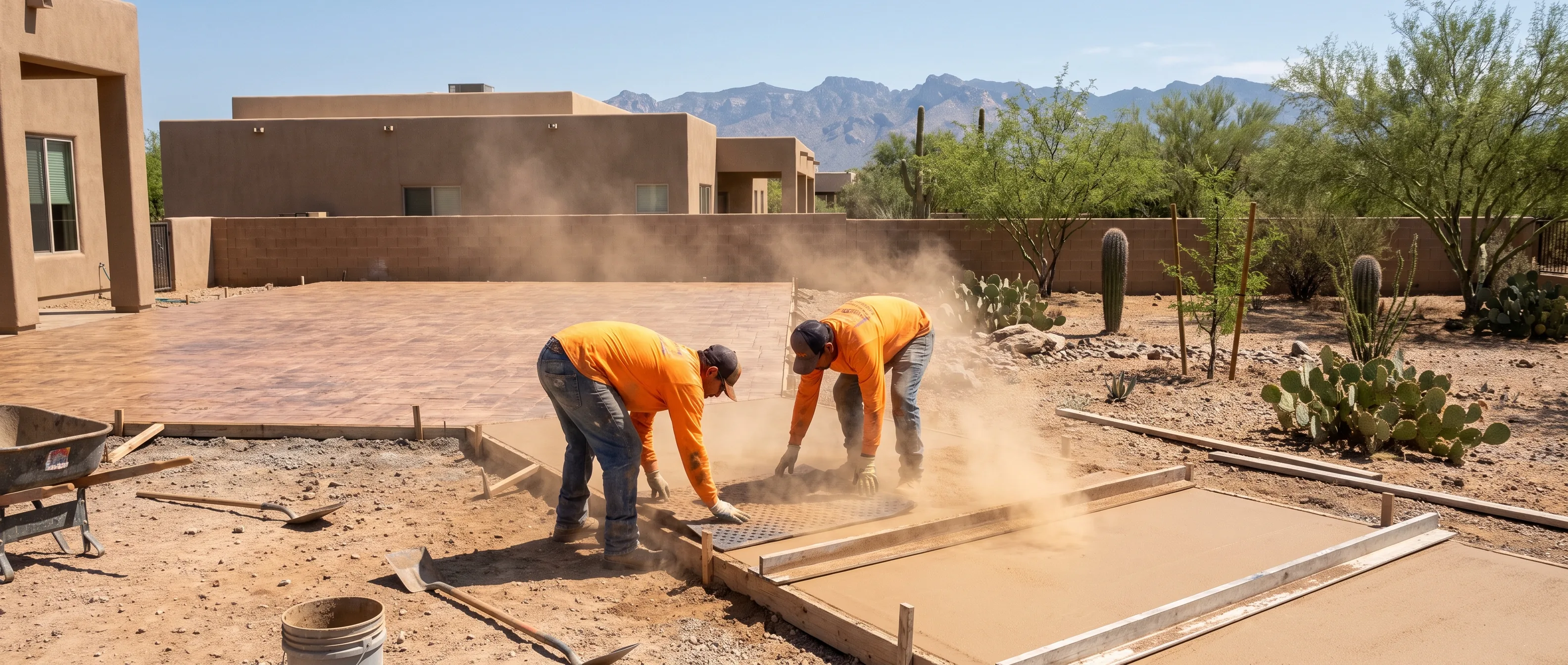
Stamped and Decorative Concrete in Tucson
Colour, texture and pattern in a poured surface. Placed with joints where the slab actually wants to crack, and specified for a sun that fades unprotected colour fast.
- Control joints planned, not improvised
- Integral colour, not colour that lives on the surface
- Reinforcement sized for the ground and the load
- Honest advice on stamped versus pavers
[ 01 ]The part you cannot see
Concrete cracks. The question is where
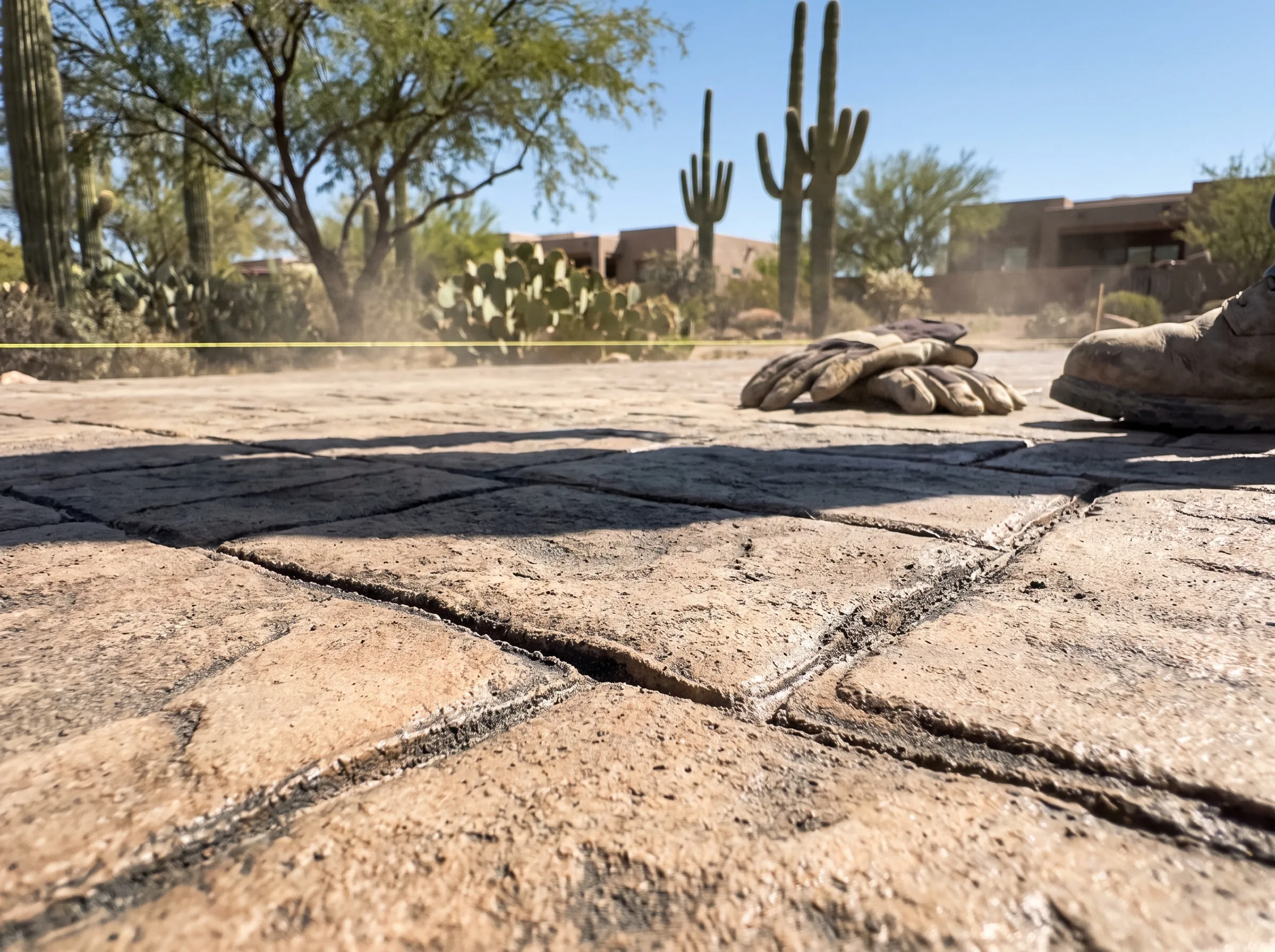
Every slab of any size will develop cracks. Concrete shrinks as it cures and it moves with temperature, and there is no admixture, no fibre and no reinforcement that prevents that entirely. What good work does is decide in advance where those cracks happen, by cutting or tooling control joints that give the slab a designated weak line to break along.
On a plain broom finished slab that is a technical matter. On stamped concrete it is also an aesthetic one, because the joint layout has to relate to the pattern, the shape of the area and the sight lines. A stamped patio with joints sawn straight through the middle of a stone pattern at odd intervals looks worse than plain concrete, and no amount of colour rescues it.
The second Tucson specific issue is colour. Ultraviolet exposure here is punishing, and decorative concrete depends on colour for its entire effect. Integral colour, mixed through the concrete rather than applied to the top, keeps its appearance far better than a surface treatment, and it does not disappear when the top layer wears at a doorway or a step.
[ 02 ]Scope
What we build
Stamped patios and pool surrounds
Coloured and textured slabs in ashlar, slate, seamless and wood plank patterns. Around a pool the texture also does a functional job, since a smooth troweled surface at a water edge is not a good idea.
Stamped and broom finished driveways
A stamped border with a broom finished field is a common and sensible combination on a drive: it gives the frontage a detailed edge without covering the whole surface in a texture that will take the brunt of tyre wear.
Colour, texture and border work
Integral colour with release accent, exposed aggregate, salt finish, banding and saw cut patterns. Useful when the goal is a surface that reads as considered rather than as a slab that happens to be there.
[ 03 ]In every scope
What is included
Subgrade and forms
Excavation, subgrade compaction, and forms set to the finished levels with the fall built in. The fall is decided before the pour, because it cannot be added afterwards.
Reinforcement and thickness
Slab thickness and reinforcement chosen for what will actually be on it, and for the ground underneath. Caliche and expansive soils behave differently and the reinforcement answers to that.
Pour, colour and stamping
Placed, screeded, floated, coloured, then stamped in a working window that does not wait for anyone. Stamping is a timed operation and it is the reason this work is crew intensive on pour day.
Joints, cure and seal
Control joints cut or tooled to the planned layout, the slab cured properly rather than left to flash off in the sun, then sealed where sealing suits the surface and the location.
[ 04 ]How it runs
How the build runs
- 01
Site visit and levels
We check where the water goes, what the slab has to tie into, and whether there is an existing slab that has already told us what the ground does.
- 02
Pattern, colour and joint layout
Pattern and colour chosen from real samples in daylight rather than from a screen, and the joint layout drawn before we quote so you can see where the lines will fall.
- 03
Fixed quote
Itemised, with square footage, thickness, reinforcement, colour, stamping and sealing shown separately.
- 04
Utilities and preparation
Blue stake locates, forms set, and a pour date scheduled around the weather. We do not stamp into a monsoon forecast.
- 05
Pour day
A single continuous operation with a full crew. Place, screed, float, colour, stamp, then joints once the slab is ready for them.
- 06
Cure and handover
The slab is protected while it cures, and we tell you honestly how long to stay off it and how long to wait before furniture goes back.
[ 05 ]Why us
Why build with us
We draw the joint layout before you sign anything. It is the difference between a stamped patio that looks designed and one that looks like a slab with lines cut in it, and almost nobody shows it to you in advance.
We use integral colour as the default. Surface applied colour looks identical on handover day and does not age the same way under this sun, particularly on a surface that gets foot traffic at a threshold or a step.
And we will tell you when pavers are the better answer. Stamped concrete on ground that moves will crack, and a crack through a stamped pattern is far more visible and far harder to repair invisibly than a settled paver is to lift and relay. We build both, so the recommendation costs us nothing either way.
Want a real number on stamped concrete?
Send us the rough dimensions and the look you are after. We will come out with samples.
[ 06 ]Questions
Stamped concrete questions
How much does a 20x20 stamped concrete patio cost?
Stamped costs more than plain concrete of the same size because pour day needs a bigger crew working to a fixed window, and because colour, release, stamping and sealing are additional materials and stages. Pattern complexity and the number of colours move the number.
Is stamped concrete patio cheaper than pavers?
Usually yes, somewhat, though the gap is smaller than people expect once colour, stamping and sealing are counted. The real difference is not price, it is what happens later. Stamped concrete that cracks is difficult to repair invisibly, while a paver surface can be lifted and relaid. If the ground is stable and the budget is tight, stamped is a reasonable choice.
What is the downside of stamped concrete?
It cracks eventually and the crack will cross the pattern. Colour fades under heavy UV exposure, particularly surface applied colour. It needs resealing periodically to keep its appearance. And repairs almost never match, because matching a cured coloured stamped surface is close to impossible.
What are the pros and cons of stamped concrete compared to regular concrete?
Stamped gives you texture, colour and a pattern for a moderate premium over a plain slab, and a textured surface is less slippery at a pool edge than a smooth troweled one. Against that, it costs more, it needs sealing to keep looking right, and the same crack that would be barely noticeable on a broom finished slab is obvious across a stone pattern.
Can you power wash a stamped concrete patio?
Carefully, at a moderate pressure, with a wide fan tip and the wand kept moving and well back from the surface. A narrow high pressure tip held close will erode the sealer, lift the release colour out of the pattern and leave permanent wand marks. If the surface is sealed, expect to reseal after an aggressive wash.
What not to clean concrete with?
Avoid strong acids, which etch the surface and strip colour, and avoid de icing style salts, which are not much of an issue in Tucson but do turn up in some cleaning products. Be careful with anything that leaves a film, since residue in the texture attracts dirt. On coloured and sealed surfaces, a neutral cleaner and a soft brush is nearly always the right starting point.
Where we build
We build across Tucson, Oro Valley, Marana, Vail, Sahuarita, Green Valley, Catalina Foothills, Casas Adobes, Rita Ranch, Dove Mountain, Corona de Tucson and Tanque Verde.
See where we build[ 07 ]Related
What people build with this
[ 08 ]Free on site quote
Get a quote for your stamped concrete
Tell us roughly how big the area is and what look you are after. We will come out with samples and quote it.
Thanks, that is with us
We will call you back, usually the same working day, and ask a few questions about the space before we come out. If it is urgent, call(520) 555-0168.