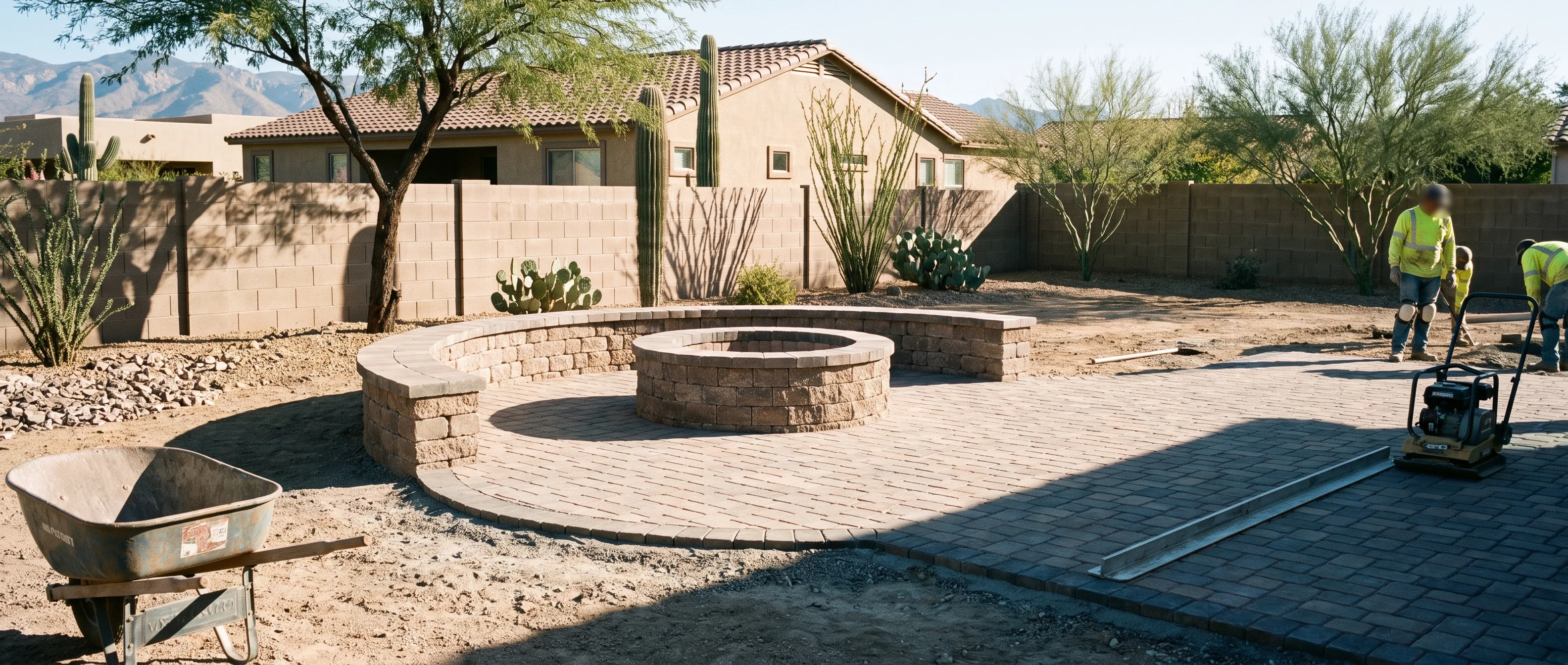
Fire Pits and Outdoor Fireplaces in Tucson
Built in block on a proper base, finished to match the hardscape around them, and sited with real clearance from the house and from anything overhead.
- Clearances checked on site, not assumed
- Gas work by licensed trade partners
- Finishes matched to the surrounding hardscape
- Seating distance set with real furniture
[ 01 ]The part you cannot see
Tucson has nine months of fire pit weather
This is one of the few outdoor features here that genuinely earns its cost. From October through May the evenings are cool enough that a fire pit is the reason people stay outside, and in a climate where the summer pushes everyone indoors, extending the other three seasons is worth something real.
The build itself is straightforward masonry. Where fire features go wrong is in siting and sizing. Too close to the house and it is unusable and unsafe. Under a shade structure without the right clearance, it is a serious hazard. Too small and the heat does not reach the seating. Too large and everyone sits further back than the seat wall you just built.
The other decision is gas or wood. In this market that is not purely a preference question. Air quality restrictions and seasonal burn conditions affect when a wood fire can be used, and a gas feature does not have that constraint. Wood gives you the thing people actually want from a fire. We build both and we will walk you through the trade off honestly.
[ 02 ]Scope
What we build
Gas fire pits
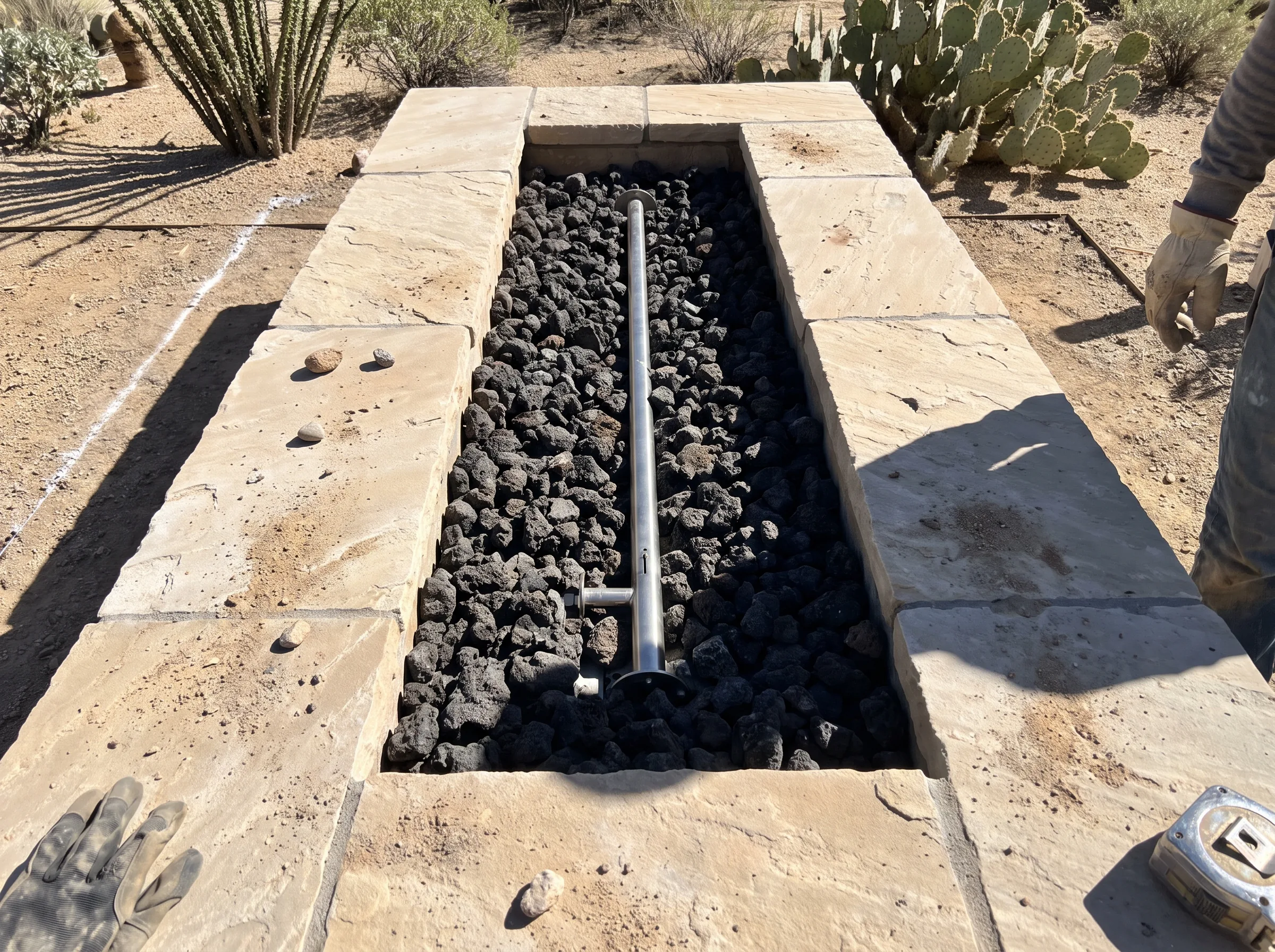
A block structure with a burner, ignition and a lava rock or fire glass bed, plumbed to a gas line or a concealed propane tank. Instant on, instant off, no smoke, and usable whenever you want it.
Wood burning fire pits
A masonry bowl or square with the correct interior detailing and no gas run to fail. Simpler, cheaper, and the thing most people actually picture. Subject to seasonal restrictions, which we will explain before you choose it.
Outdoor fireplaces and chimneys
A vertical structure with a firebox and flue, which throws heat in one direction and doubles as a wind break and a visual anchor. A significantly larger build than a pit, and one that usually needs a permit.
[ 03 ]In every scope
What is included
Siting and clearances
We site the feature on the ground with you, check clearance to the house, to walls, to planting and to anything overhead, and confirm what the surface underneath it can take.
Footing and structure
Poured footing where the size requires it, block shell, reinforcement and grouted cells. Fire features are heavy and they are the last thing you want settling unevenly.
Burner, gas and ignition
On gas builds, the burner sized to the opening, the gas run installed and pressure tested by licensed trade partners, and the ignition system commissioned with you present.
Finish, cap and surround
Stone veneer, stucco or tile to match the surrounding hardscape, a capstone or hearth, and any seat wall or paver surround built to sit at the right distance.
[ 04 ]How it runs
How the build runs
- 01
Site visit and siting
We mark the location on the ground and check the prevailing wind direction, because smoke and heat going straight at the back door is the most common siting mistake.
- 02
Gas or wood, and sizing
The fuel decision made with the restrictions explained, and the size set by how many people actually need to feel the heat.
- 03
Fixed quote
Itemised with structure, burner and gas, finish and surround separated, and any permit cost identified.
- 04
Permits, utilities and trades
Blue stake locates before we dig. Where a gas run or a fireplace structure needs a permit, we handle the submittal and book the licensed trades.
- 05
Build
Footing, block, rough in, inspection where required, finish, cap, then commissioning.
- 06
Lighting and handover
We light it with you there, check every connection on a gas build, and go through operation and shut off before we leave.
[ 05 ]Why us
Why build with us
We site it before we build it. Twenty minutes standing in the yard with real chairs, checking wind direction and the distance to the house, prevents the most common regret about this feature, which is that nobody uses it.
We treat clearances as a safety matter rather than a formality. A fire feature under a ramada or near a shade structure needs specific clearance to combustibles overhead, and it is the detail most likely to be waved through by someone who wants the job.
And the gas goes to licensed trades. We build the structure, they run and test the gas, and it is commissioned with you present. There is no version of this where a fire feature is worth cutting a corner on.
Want a real number on a fire feature?
Send us a photo of the space and tell us how many people you want it to seat. We will come out and site it with you.
[ 06 ]Questions
Fire pit questions
How much does it cost to install a firepit?
A wood burning masonry pit is the entry point. A gas pit adds the burner, the ignition and the gas run, and the length of that run from the meter is often the biggest single variable. An outdoor fireplace is a much larger structure and typically several times the cost of a pit.
Is it better to have a fire pit in the ground or above ground?
Above ground is better for almost every residential situation here. It puts the heat at a useful height for people sitting around it, it gives you an edge to build a hearth or seat on, and it is far easier to keep clear of debris and runoff. A sunken pit collects water and grit during monsoon season and sits below the heat line of anyone in a chair.
How far away from a house should a fire pit be placed?
Further than most people initially plan. The distance needs to account for the house wall, the eaves, any shade structure overhead, planting, and where the smoke will go on a normal evening wind. There is a required minimum clearance and there is a comfortable working distance, and they are not the same number. We check both on site rather than quoting a rule.
What should a fire pit sit on?
A stable, non combustible surface with a footing appropriate to the weight of the structure. A masonry fire feature is heavy and it should not be built on unprepared ground or on a surface that has already settled. If it is going on an existing patio, we check that the surface underneath can take the load before we build on it.
What is the best thing to put in the bottom of a fire pit?
On a gas feature, the burner sits in a bed of lava rock or fire glass rated for the purpose, and the media has to be the correct type and depth for the burner. On a wood pit, a layer of non combustible material with drainage below it, so water does not pool in the bowl after a storm. Never use river rock or any stone that can hold moisture near heat, because trapped water can cause it to fracture.
Does having a fire pit increase your insurance?
That is a question for your insurer rather than for us, and the honest answer is that it depends on the policy and the installation. It is worth a phone call before you build, particularly for a permanent gas feature, because some policies want to know about it and some do not care.
What are the laws about fire pits in your backyard?
Open burning and wood burning are subject to local air quality rules and seasonal restrictions, gas features are generally treated differently to wood, and permanent installations with a gas run have their own requirements. We check the current position for your address before building.
Where we build
We build across Tucson, Oro Valley, Marana, Vail, Sahuarita, Green Valley, Catalina Foothills, Casas Adobes, Rita Ranch, Dove Mountain, Corona de Tucson and Tanque Verde.
See where we build[ 07 ]Related
What people build with this
[ 08 ]Free on site quote
Get a quote for your fire feature
Tell us where it would go and how many people you want it to seat. We will come out and site it with you.
Thanks, that is with us
We will call you back, usually the same working day, and ask a few questions about the space before we come out. If it is urgent, call(520) 555-0168.