Paver Walkways and Steps in Tucson
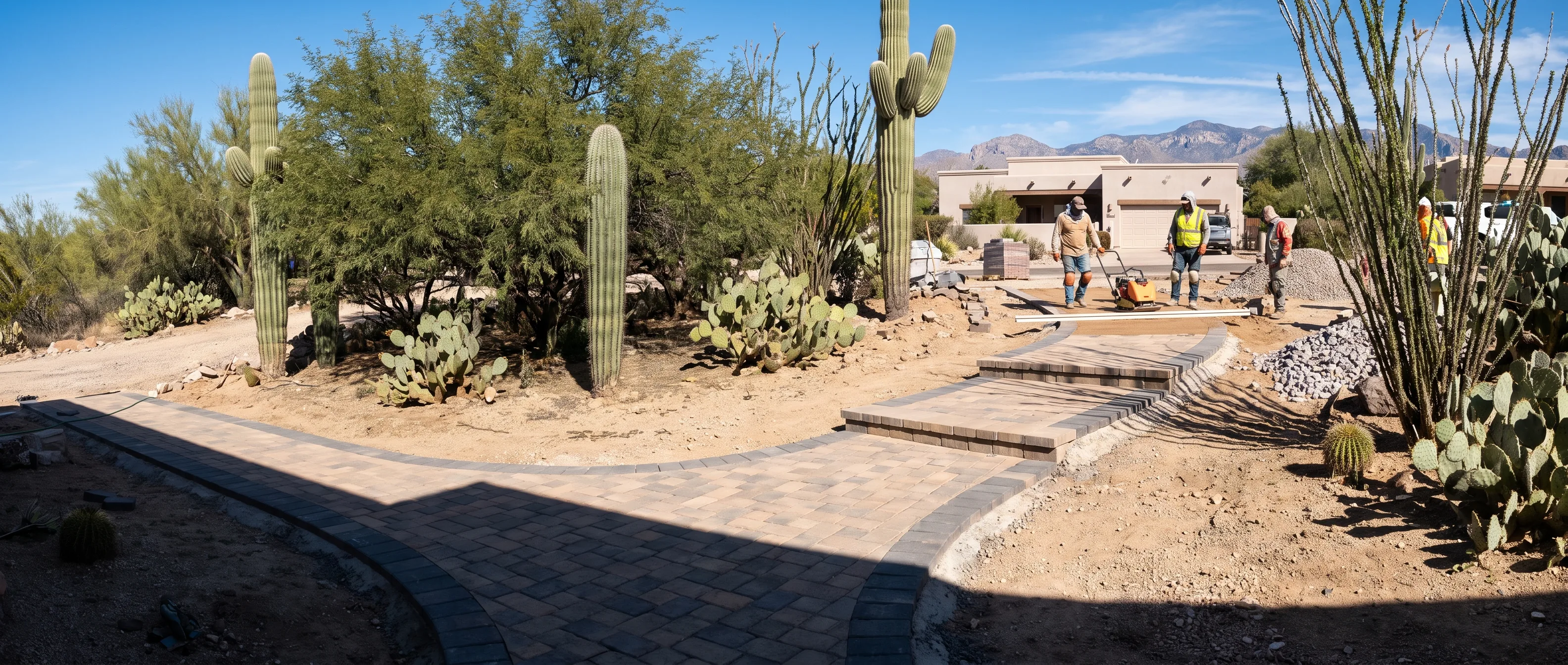
Front paths, side yard runs and entry steps. Set to a consistent rise and run, restrained on both edges, and lit by the same sun that will be on them at four in the afternoon.
- Consistent rise and run on every step
- Both edges restrained on a narrow path
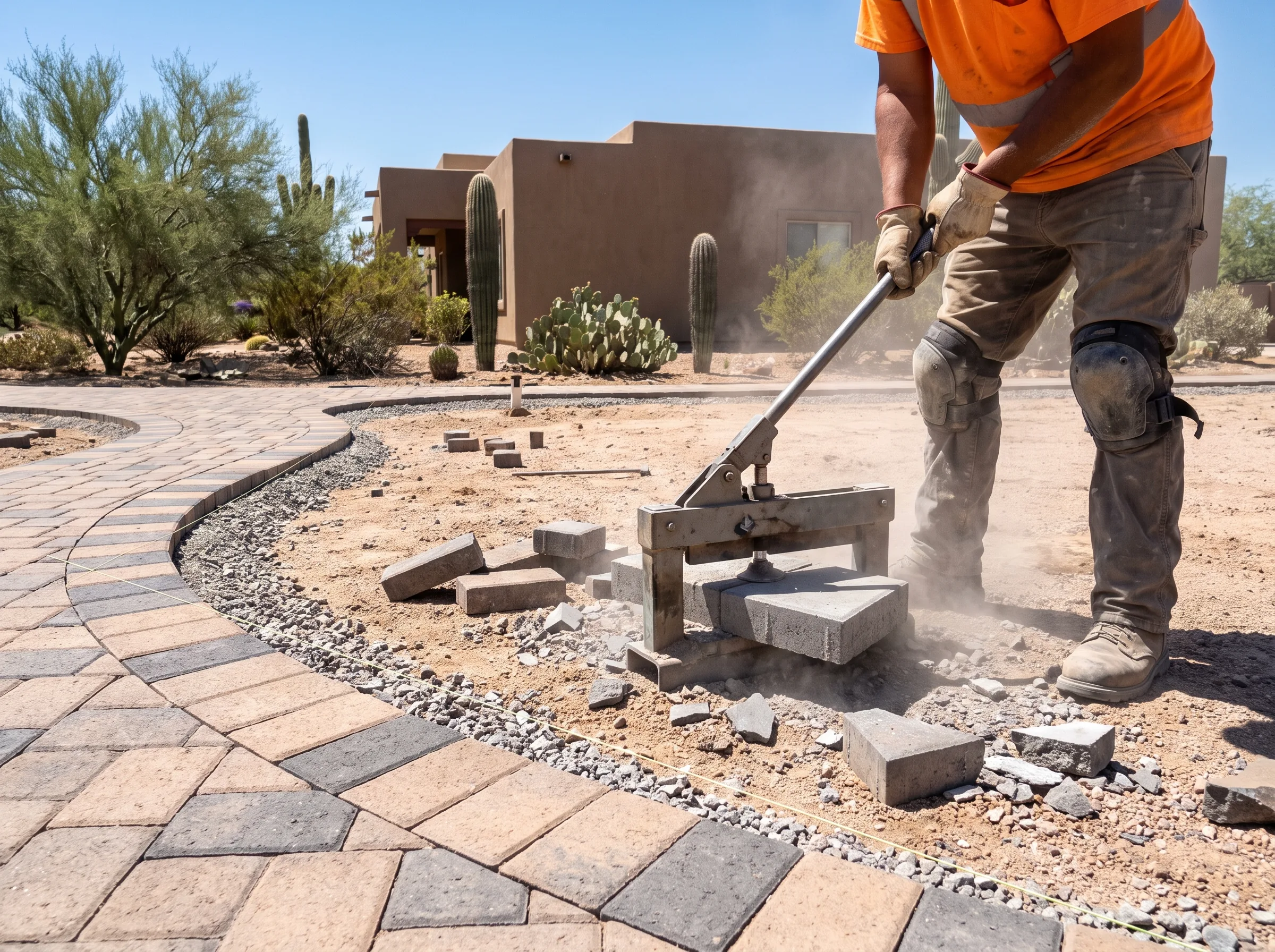
- Cuts made on a saw, not snapped by eye
- Fall taken away from the house and the entry
[ 01 ]The part you cannot see
Narrow surfaces have nowhere to hide
A walkway is one of the least forgiving things to build well. A patio is wide, so a small variation in level disappears into the field. A path is often three feet across, which means every edge is an outside edge, every cut is visible, and any wander in the line is obvious from thirty feet away because there is a straight house wall next to it for comparison.
Steps are harder again. The human foot notices a rise that varies by a quarter of an inch, and it notices it by tripping. Consistent rise and run is not a nicety on an entry step, it is the difference between a path people walk without thinking and one they learn to be careful on.
Then there is the desert specific problem. Front paths run through DG and gravel fields, and without proper restraint the loose material migrates onto the path and the path edge migrates into the loose material. Within two years the crisp line you paid for has blurred into a general gravelly zone.
[ 02 ]Scope
What we build
Front entry paths
From the drive or the street to the door, usually with a step or two at the entry and often on the shadeless west side of a house. Width matters more than people expect, because two people should be able to walk in together.
Side yard runs and utility paths
The narrow strip between the house and the wall, which is usually the route material takes to the back yard and is usually a mud channel in monsoon season. A restrained paver run fixes both problems.
Steps, landings and grade changes
Entry steps, terrace steps between levels, and landings where a path turns. Built on footings rather than stacked on compacted fill, so the rise stays the rise.
[ 03 ]In every scope
What is included
Layout and setting out
The route marked on the ground so you can walk it before it is built. Curves set with a radius rather than eyeballed, because a freehand curve reads as a mistake once pavers are in it.
Excavation, base and bedding
Excavation to depth, subgrade compaction, aggregate base compacted in lifts, then screeded bedding. The base extends past the paver edge so the restraint has something solid to sit on, which is the detail most often skipped on narrow paths.
Steps and structural elements
Where the path steps, the risers are built on a footing and the treads are set with a consistent rise and a consistent going, checked with a level across every step rather than assumed from the first one.
Edging, joints and clean up
Restraint spiked along both edges, joint sand swept and settled, the field compacted, then the path washed down and the surrounding DG or gravel raked back to a clean line.
[ 04 ]How it runs
How the build runs
- 01
Site visit and route
We walk the route with you, look at where people actually cut the corner, and check the fall from the house outward. Paths get built where the desire line already is, not where a drawing says.
- 02
Layout and materials
The route marked out on the ground, width agreed by standing in it, and paver and border chosen to relate to the house rather than to the back yard patio.
- 03
Fixed quote
Itemised by linear foot and by step, with base depth and restraint spec stated.
- 04
Utilities and access
Blue stake locates before we dig. Irrigation lines are the usual find on a front yard path and we reroute rather than cut and hope.
- 05
Build
Excavate, compact, base in lifts, screed, lay, cut, restrain, sand, compact. Steps built and cured before the runs either side are finished into them.
- 06
Walkthrough
We walk it with you, literally, checking every step for consistent rise before we call it done.
[ 05 ]Why us
Why build with us
We restrain both edges. On a narrow path that is twice the restraint material and twice the labour of a patio edge per square foot of surface, and it is the first thing cut on a cheap quote. It is also the only thing preventing a path from spreading into the gravel either side.
We build steps on footings. Stacked risers on compacted fill move, and when they move the rise changes and the step becomes a trip hazard. This is the detail we are least willing to negotiate on, because it is the one with a safety consequence.
And we think about the sun. A west facing front path in Tucson gets brutal afternoon exposure, and a dark paver on that path will be genuinely unpleasant underfoot in July. We will say so before you choose the colour, not after.
Want a real number on your walkway?
Send us a photo of the route and roughly how long it is. We will come out and quote it properly.
[ 06 ]Questions
Walkway and step questions
How do I prepare the ground for pavers?
Strip the loose surface material, dig to a depth that suits the ground and the use, compact the subgrade, then build aggregate base up in lifts with a compactor pass on each lift. The bedding layer goes on last and is thin. On a narrow path the prepared area needs to extend past the paver edge so the restraint sits on compacted base rather than on soil.
What is the best base to put under pavers?
A well graded crushed aggregate that compacts and locks together, placed in lifts and compacted at each one. Depth depends on what the ground is and what will cross the surface. What matters more than the brand of stone is that it is compacted properly and that it does not sit in water, which in Tucson usually means paying attention to whether caliche is trapping moisture underneath.
What are common mistakes to avoid when laying pavers?
Too little base, compacting once at the end instead of in lifts, using the bedding sand to correct an uneven base, leaving the edges unrestrained, and laying without a string line so the joint pattern drifts. On steps, the mistake is varying rise, which is the one that hurts someone.
What happens if I don't put gravel under pavers?
The pavers sit on soil that compacts unevenly under load and washes out at the edges during monsoon runoff. Low spots develop first, then the joints open, then the field starts to move. On a path it happens faster than on a patio because the loads are concentrated on a narrow strip.
Are pavers considered a permanent structure?
For most practical purposes yes, they are a permanent improvement, though they are also removable and reusable in a way that poured concrete is not. Whether a specific installation counts as a permanent structure for permitting or assessment purposes depends on the jurisdiction and the detail, so we check that for your address rather than generalising.
Where to buy pavers in Tucson?
There are several suppliers and yards in the metro and we are happy to point you at them, but we should be straight with you: we are a construction company, we do not sell materials over the counter, and the material is a small part of an installed price. If you are pricing a supply only purchase to compare against a quote, ask the quoting contractor for their base spec too, otherwise the comparison is not meaningful.
Where we build
We build across Tucson, Oro Valley, Marana, Vail, Sahuarita, Green Valley, Catalina Foothills, Casas Adobes, Rita Ranch, Dove Mountain, Corona de Tucson and Tanque Verde.
See where we build[ 07 ]Related
What people build with this
[ 08 ]Free on site quote
Get a quote for your walkway
Tell us roughly how long the route is and whether there are steps. We will come out, walk it, and give you a real number.
Thanks, that is with us
We will call you back, usually the same working day, and ask a few questions about the space before we come out. If it is urgent, call(520) 555-0168.