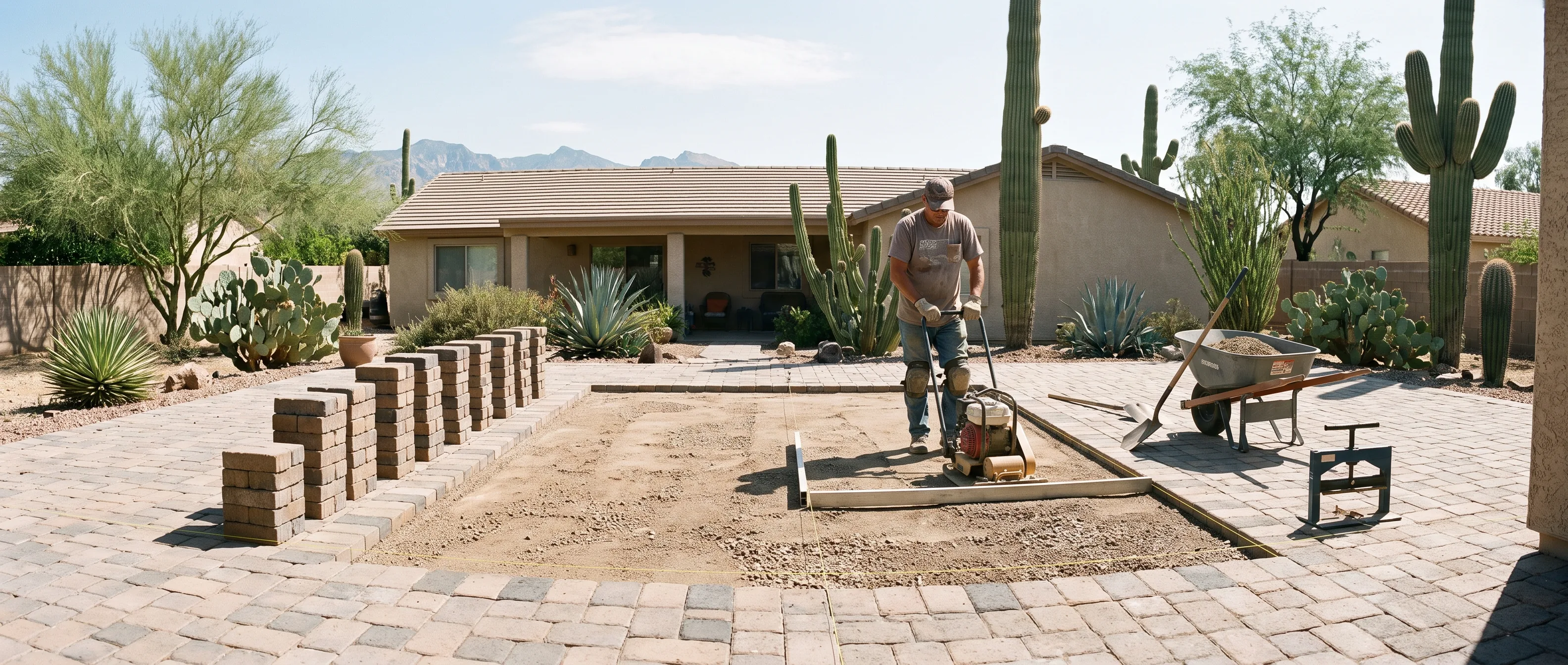
Paver Repair and Sealing in Tucson
Settled areas lifted and the base underneath corrected, not just the top reset. Joint sand replaced. Sealer applied only where sealing is genuinely the right answer.
- We fix the base, not just the surface
- Existing pavers reused wherever they are sound
- Honest advice on whether to seal at all
- Sealer specified for desert UV exposure
[ 01 ]The part you cannot see
Settlement is a symptom, not the problem
When a paver patio dips near the door or a driveway develops two shallow ruts in the wheel path, the pavers are almost never the issue. They are reporting on something underneath: base that was too thin, base that was never compacted properly, or water that has been washing fines out from under the surface every monsoon season for years.
There is a cheap version of this repair where someone lifts the sunken pavers, throws sand under them, taps them back down and leaves. It looks fixed. It is flat again for maybe a season, and then the same area sinks again, because nothing that caused the settlement was addressed.
We do it the longer way. Lift the affected area, find out why it moved, correct the base and the drainage that caused it, then relay the same pavers. Usually the pavers are perfectly serviceable, which means most of the cost is labour and the material bill is small.
Sealing is a separate question and we treat it as one. It is sold hard in this market and it is not always the right call.
[ 02 ]Scope
What we fix
Settled and sunken areas
Dips, low spots and the classic depression where a downspout has been discharging onto the same square foot for years. We lift, correct the base, deal with the water source, and relay.
Failed joints and weed growth
Joint sand that has washed out, blown out, or was never properly settled in the first place. Open joints let the field move and let weeds establish, and both get worse from there.
Spread edges and wandering borders
Fields that have crept outward because there was never a restraint, or the restraint has failed. This one needs the edge rebuilt rather than the pavers pushed back, because they will simply move again.
[ 03 ]In every scope
What is included
Assessment and cause
Before anything is lifted we work out why it moved. If the cause is a roof downspout, an irrigation leak or a grade that sends water into the area, repairing the surface without fixing that is money wasted and we will say so.
Lift, correct and relay
Affected pavers lifted and stacked in order, base corrected and recompacted to the proper depth, bedding re screeded, then the same pavers relaid. Replacements only where a paver is genuinely broken.
Joint sand replacement
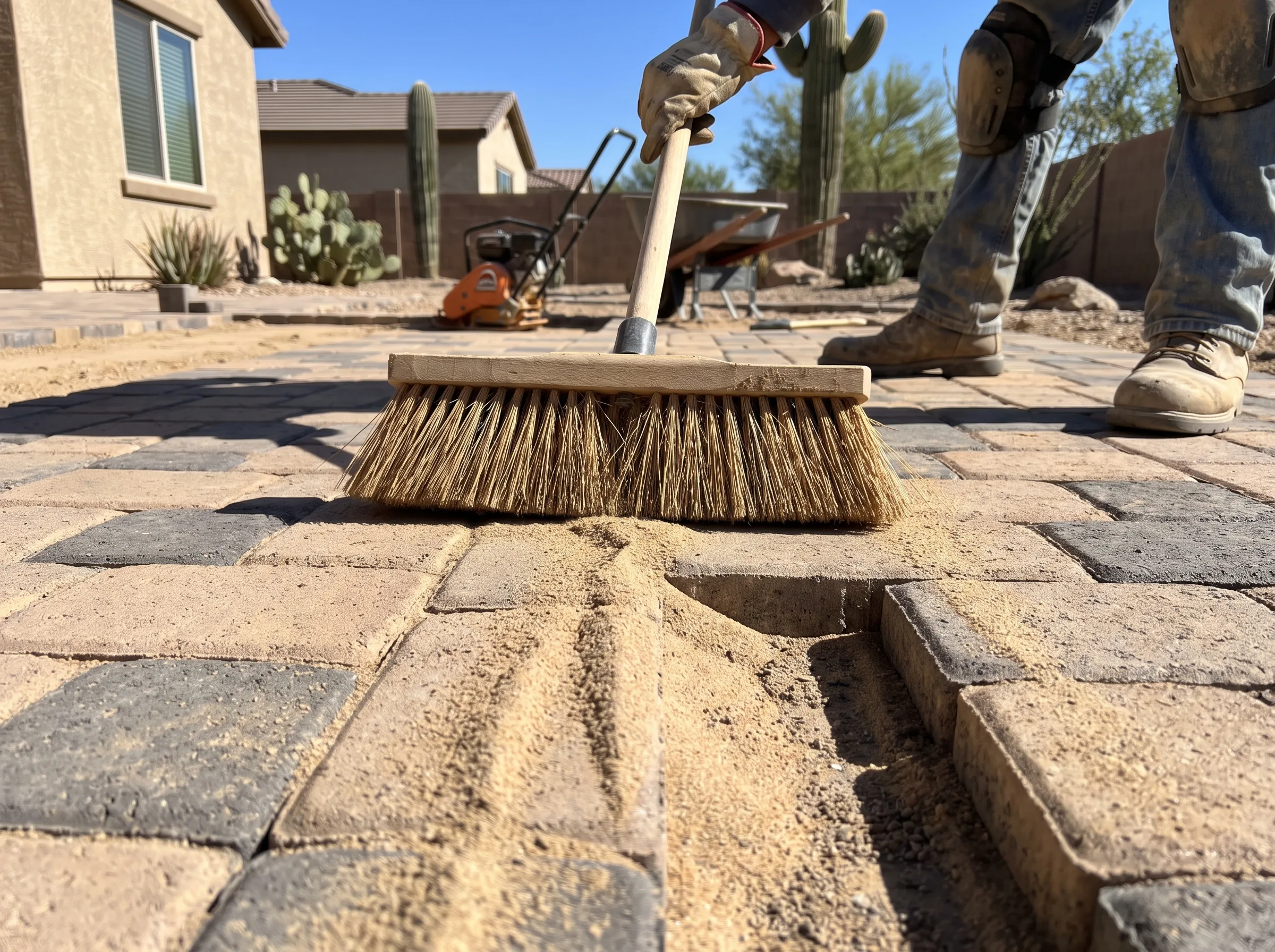
Old joint material cleaned out, new sand swept in, the field compacted with a protective pad and the joints topped up. On areas prone to washing out we will recommend a polymeric product and explain the trade offs.
Cleaning and optional sealing
Surface cleaned, stains treated where they can honestly be treated, then sealer applied only if it suits your situation. If we think you should not seal, that is what we will tell you.
[ 04 ]How it runs
How the work runs
- 01
Site visit and diagnosis
We look at the failure, check the surrounding grade, and find the water. Most paver failures in Tucson trace back to where water goes during a storm.
- 02
Scope and honest options
Sometimes the right answer is a small repair. Sometimes an area has been rebuilt so many times that replacing it properly is better value than fixing it again. We will lay out both and tell you which we would do.
- 03
Fixed quote
Itemised by area, with the cause fix listed separately from the surface work so you can see what you are paying for.
- 04
Preparation
Furniture moved, area cleared, and where a downspout or irrigation line is the culprit, that gets sorted before the surface goes back.
- 05
Repair
Lift, correct, recompact, screed, relay, sand, compact. Cleaning and sealing follow on a separate visit if sealing is in scope, because the surface has to be genuinely dry first.
- 06
Walkthrough
We show you what was under there, which is usually the most convincing part, and leave joint sand for topping up.
[ 05 ]Why us
Why bring us in
We diagnose before we quote. A repair priced without knowing why the area moved is a guess, and it is usually a guess that will need repeating.
We are also willing to talk you out of sealing. Sealer gets sold aggressively here because it is high margin and quick, and there are real situations where it helps: colour enhancement, stain resistance on a surface near a cooking area, stabilising joint sand on a windy exposed site. There are also situations where it traps moisture, changes the surface underfoot, and commits you to reapplying every few years. We will tell you which one you are in.
And we reuse your pavers. A repair where most of the material already exists on site should not be priced like a new installation.
Got a dip, a rut or open joints?
Send us a photo and tell us how long it has been getting worse. We will come and look at it.
[ 06 ]Questions
Repair and sealing questions
Is there a downside to sealing pavers?
Yes, several, which is why we do not treat it as automatic. Sealer changes the appearance permanently, it can make a surface slicker when wet, a wet look product on a shaded area can trap moisture, and once you start you are committed to reapplying every few years or living with a patchy finish as it wears. Under intense Tucson UV, a poorly chosen product can cloud or yellow surprisingly fast. It is worth doing for the right reasons on the right surface, and it is not worth doing just because someone knocked on your door.
Why put sand in between pavers?
The joint sand is what makes an interlocking pavement work. It transfers load from one paver to its neighbours so the field behaves as a single surface rather than as a few hundred separate blocks. Without it every paver carries its own load, they rock individually, the edges chip, and the field starts to spread.
Will Dawn dish soap clean pavers?
It will lift light grease and general grime, and it is fine for a small spot. It is not the right tool for hard water deposits, efflorescence or oil that has soaked in, which are the three most common staining problems here. Be careful with anything acidic on pavers, and rinse thoroughly, because residue left in the joints attracts dirt and can affect a sealer applied later.
What is the average lifespan of brick pavers?
The pavers themselves generally outlast everything else in the assembly and are commonly still serviceable decades on. What wears out on a shorter cycle is the joint sand, any sealer, and eventually the base if water has been getting into it. That is why paver problems are usually repairable: you are replacing the components that failed, not the surface.
Do pavers get hot?
Yes, and colour matters more than material. A dark charcoal paver in full Tucson sun in July will be genuinely uncomfortable barefoot, while a light tan or buff one in the same spot is noticeably more tolerable. If a surface has already been laid in a dark colour, shade is the practical fix rather than a coating, and it is worth knowing that a sealer generally does not reduce surface temperature.
Where we work
We work across Tucson, Oro Valley, Marana, Vail, Sahuarita, Green Valley, Catalina Foothills, Casas Adobes, Rita Ranch, Dove Mountain, Corona de Tucson and Tanque Verde.
See where we build[ 07 ]Related
What people build with this
[ 08 ]Free on site quote
Get a quote for your repair
Send us a photo of the problem area and roughly how big it is. We will come out and tell you what is actually going on under there.
Thanks, that is with us
We will call you back, usually the same working day, and ask a few questions about the space before we come out. If it is urgent, call(520) 555-0168.